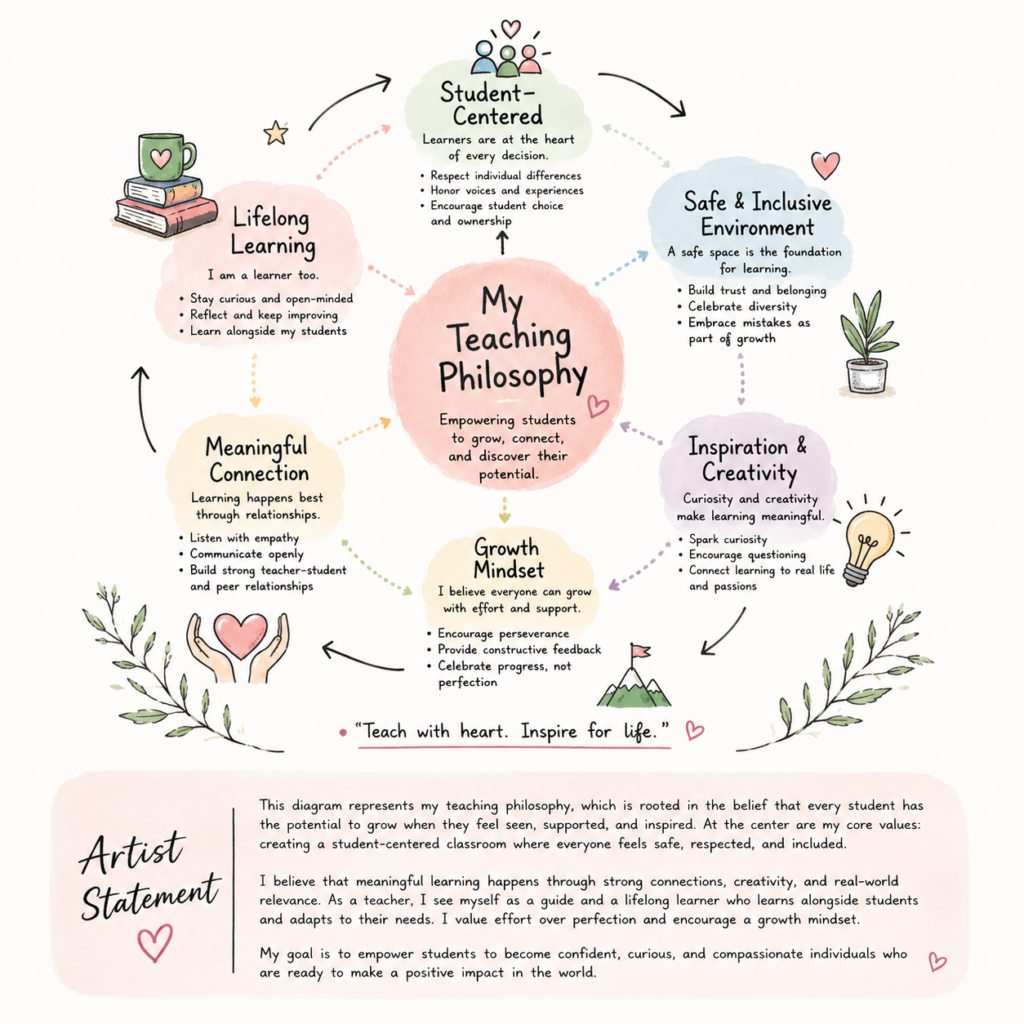
This diagram represents my teaching philosophy, which is based on the belief that every student has the potential to grow when they feel supported.
It describes my core values: creating a student-centered classroom where everyone feels safe, respected, and included.
I believe that meaningful learning happens through strong connections. I use creativity and real-world relevance to help this process.
As a teacher, I see myself as a guide who learns alongside students based on their needs.
I value effort over perfection. I value a growth mindset.
My goal is to empower students to become confident and compassionate individuals who are ready to make a positive impact in the world.
Standard 9 Educators respect and value the history of First Nations, Inuit, and Métis in Canada and the impact of the past on the present and the future. Educators contribute towards truth and reconciliation. They also create a deeper understanding of ways of knowing and being in the and cultures of First Nations. They examine their own biases, support positive attitudes, grow fresh beliefs, extend indigenous values, and assist in understanding of practices to facilitate change. Educators value and respect the languages, heritages, cultures, and ways of being of First Nations, Inuit and Métis. They are responsible for sharing the understanding and power of focusing on interconnectedness and relationships to oneself, family, community and the natural world. It is vital that educators integrate First Nations worldviews and perspectives into learning environments.
Standard 9 focuses on respecting and valuing Indigenous histories, cultures, worldviews, and ways of knowing and being. During this learning process, my understanding of Indigenous education has changed a lot. I now understand that learning about Indigenous perspectives is not something we finish once, but an ongoing process as educators.
Before entering the program, I did not know very much about Indigenous education in Canada. As an international student and someone from China, most of my previous education focused on world history and academic knowledge. I knew Indigenous peoples existed in Canada, but I did not fully understand the history of colonization, residential schools, or how these experiences still affect communities today.
At the same time, being Chinese also shaped how I connect with this learning. China has its own history of war, invasion, and cultural trauma. Although these experiences are different from Indigenous experiences in Canada, learning about intergenerational trauma and cultural loss helped me better understand how history can continue to affect people, families, and communities for a long time. This helped me approach Indigenous education with more empathy and humility.
Throughout the program and my practicum placements, I learned more about the importance of including Indigenous perspectives in respectful ways. I realized Indigenous content should be present as part of everyday learning, and not only appear during special events or holidays.
During my classes, I saw teachers use storytelling, talking circles, and reflection activities to help students share ideas and build relationships. In one class, a teacher read a story by an Indigenous author and discussed the importance of community and connection to the land. I noticed students were very engaged because they could connect the story to their own experiences and families. I also tried to include different perspectives in my own lessons and encouraged students to think about whose voices are missing in history and literature.
Another important thing I learned was the importance of creating a classroom environment where students feel connected. Indigenous ways of knowing often focus on relationships and community, and I try to bring these values into my teaching practice through collaboration, and reflection activities.
At the same time, I know I still have a lot to learn. In the future, I want to continue learning from Indigenous educators, as well as visit more local communities. I also aim to attend professional development opportunities related to Indigenous education and cultural teaching. As an educator in British Columbia, I understand and believe it is my responsibility to continue reflecting on my practice and support reconciliation through meaningful actions in the classroom. I hope to continue growing in my understanding, becoming a teacher who creates inclusive learning environments for all students.